# The Evolution of Money: Why Your Brain Was Never Built for Finance
For most of human history, we lived without money.
Not without value. Not without exchange. But without money.
As hunter-gatherers, everything we needed came directly from the world around us. Food, shelter, companionship, community. Trade existed, sure. But more often, value was shared. Not tracked. Not measured. Not stored.
Reciprocity lived in memory, trust, and reputation. Not in numbers or coins.
!The evolution of money from shells to satoshis
Why Money Feels So Hard
Here is the part we keep missing: while our environments have changed dramatically, our brains have not.
We are biologically wired for immediacy. Eat now, share now, use now. We did not evolve with an instinct to "store value" because, until very recently, there was nothing to store.
We are brilliant at reading emotions, building relationships, spotting threats. But understanding interest rates? Budgeting decades into the future? Investing in invisible, intangible "value"? Those are alien skills for a brain that was shaped by the savannah.
This is evolutionary mismatch at its most personal. And it is why money causes so much stress, confusion, and even shame for so many people. Not because they are irrational. Because money, as we use it today, is profoundly unnatural.
Three Economies, One Tribe
I have seen this firsthand.
When I visited the Hadza people of Tanzania, one of the last true hunter-gatherer societies on Earth, I watched how they still live in a gift economy. When someone brings back meat, they share it freely. It is about status, bonding, and tribe. Not price tags.
They also barter with neighboring tribes. Meat for tools. Arrows for honey. And lately, due to tourism, they have started using fiat currency as well.
So in one small community, three economic models function side by side: gifting, bartering, and money. You can feel how each one fits, or does not fit, with human nature.
Shells, Seeds, and the Birth of Currency
As societies scaled, old systems broke down. A sheep herder might want eggs, but the egg farmer needed firewood, not wool. Multi-step bartering became too complex. What we needed was a universal placeholder that could store and transfer value across time, people, and professions.
Early money came in many forms: salt, beads, cocoa beans, cowrie shells. They were beautiful, portable, and scarce. Until they were not.
If you discovered a new cowrie source, you could flood the market and collapse its value. And so began our first brush with inflation.
The solution? Control. Someone, usually a king or a priest, decided what counted as money and what it was worth.
Money became not just a tool but a symbol of power. And that has never changed.
!The history of money and currency evolution
Coins, Debasement, and the Original Con
Around 600 BCE, Lydia (modern-day Turkey) began minting metal coins stamped with royal seals. These were backed by actual gold or silver.
But it did not take long for rulers to realize they could manipulate the system.
In ancient Rome, Emperor Nero dropped the silver content of the denarius from 94% to 85%. Later emperors took it even lower. Eventually, Roman coins were mostly copper with a silver wash. Trust collapsed. Prices soared. The empire, like its currency, corroded from within.
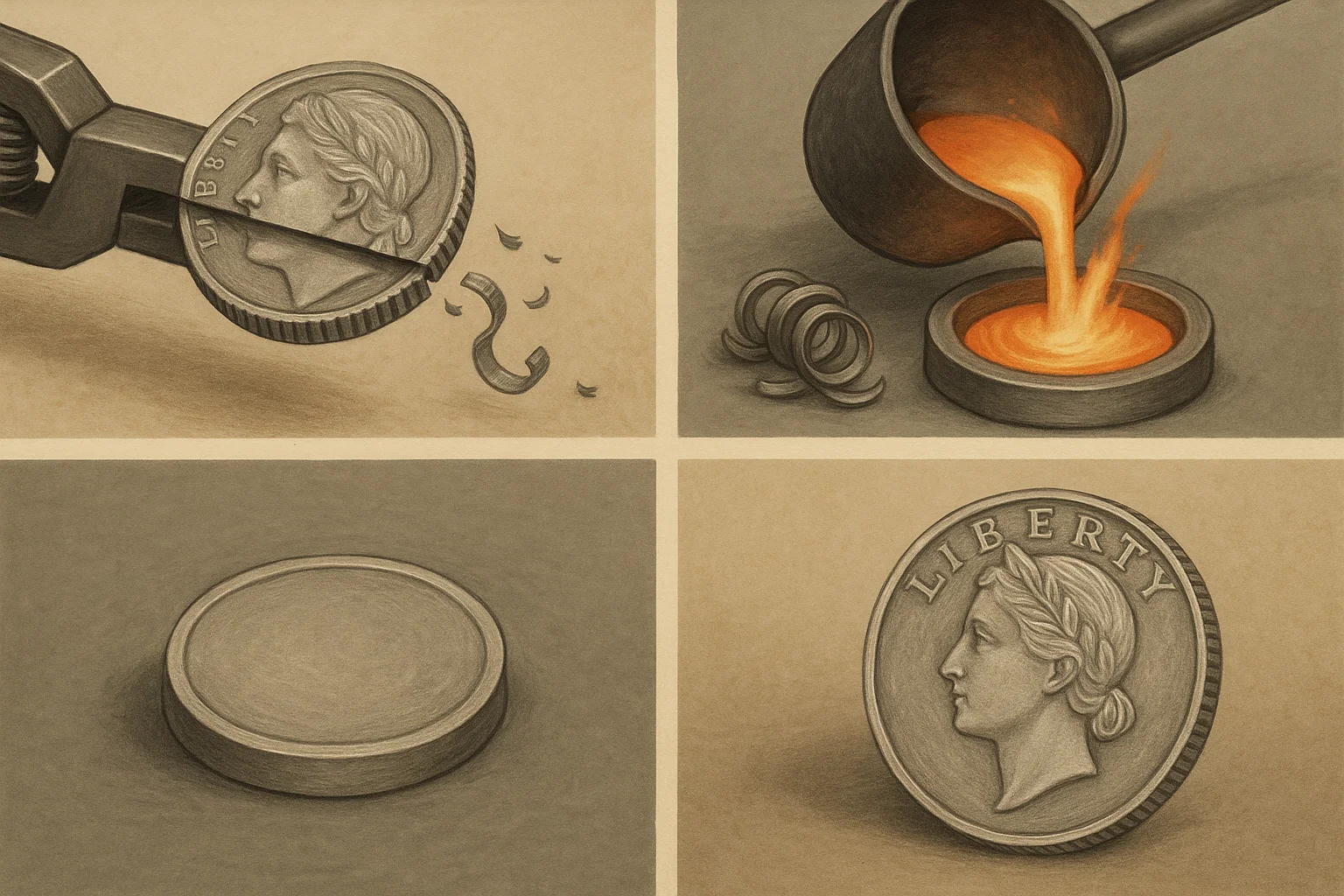
In medieval Europe, citizens clipped coin edges to steal slivers of metal. But kings did it too. Shaving coins to stretch the treasury while pretending nothing had changed.
Money had become a game between those who created value and those who quietly siphoned it off.
Sound familiar?
Paper Promises and Modern Inflation
China introduced paper money in the 7th century. Europe followed centuries later.
In 18th-century France, John Law printed vast sums to fund the Mississippi Company. When the bubble burst, the currency collapsed. That pattern repeated in Weimar Germany. In Zimbabwe. In Venezuela. And, less dramatically but just as systemically, in the modern West.
Today, governments do not print money with ink. They do it with keystrokes.
In response to the 2008 financial crisis, the U.S. Federal Reserve created trillions through "quantitative easing." During COVID, it ramped up even further. Over 40% of all U.S. dollars in existence were created in just two years, between 2020 and 2021.
The result? Asset prices soared. Not because homes or stocks got better. Because the money got worse.
This is inflation. But let me call it what it really is: a quiet tax on savers and on anyone trying to do the responsible thing with their earnings.
Bitcoin: A Return to Scarcity
In 2009, Bitcoin arrived with a radical proposition. No central bank. No printing press. No way to cheat.
Just 21 million coins. Ever. No more.
Bitcoin solved three ancient problems at once: unlimited supply, invisible debasement, and centralized control. It is not perfect. But it is consistent, transparent, and decentralized. Governed by consensus, not decree.
Critics love to shout about its energy use. But global banking requires buildings, servers, climate control, and personnel running around the clock. Bitcoin uses electricity to secure the network. When idle, it rests silently on the blockchain.
Here is what I find most interesting: Bitcoin makes intuitive sense in a way that fiat currency does not. It is scarce. Trackable. Holdable. It rewards long-term thinking. That is something our instincts can actually get behind.
!Bitcoin and the future of money
El Salvador and the Power Question
In 2021, El Salvador adopted Bitcoin as legal tender. The move was bold: reduce reliance on the U.S. dollar, include the unbanked, and invite innovation.
But soon after, the country's $1.4 billion IMF loan negotiations stalled. By 2024, under pressure, El Salvador rolled back parts of its Bitcoin legislation to regain access to funding.
This was never just about economics. It was about control.
Bitcoin removes the power to quietly devalue money. To tax citizens through inflation. It threatens the core mechanism of state monetary control. That is why it is feared.
Back to Human Nature
We were not built for spreadsheets, bond yields, or monetary policy. We were built for food, for trade, for sharing, and for trust.
Fiat money does not fit our instincts. It exploits them. Bitcoin narrows the gap. It brings predictability back into a system that has been rigged for unpredictability since the first king shaved the first coin.
I write about this kind of mismatch in The Gap book because understanding where our biology clashes with modern systems is the key to navigating them with clarity.
So here is the question worth sitting with: who should control your money? A king? A central bank? A committee in Brussels or Washington? Or a global network of stakeholders who cannot change the rules without your consent?
Money has always been about more than trade. It is about power. It is about trust. And if we want to build a more honest financial future, we need to start by fixing the most mismatched tool of all: money itself.
This is one of the most consequential evolutionary mismatches we face. And it intersects directly with business and leadership because every decision about value, compensation, and investment is filtered through a brain that was never designed for any of it.


Frequently Asked Questions
Intelligence is not the issue. Human brains evolved for immediate, tangible exchanges in small groups. Abstract financial concepts like interest rates, inflation, and long-term investing are profoundly unnatural for a brain shaped by hunter-gatherer life. The stress comes from evolutionary mismatch, not personal failure.
Fiat currency can be printed without limit, debased invisibly, and controlled centrally. These qualities conflict with human instincts around scarcity and trust. Bitcoin is capped at 21 million coins, is transparent, and is governed by consensus. Its built-in scarcity aligns more naturally with how humans have always understood value.
Evolutionary mismatch describes the gap between the environment our biology was shaped for and the modern world we actually live in. Our ancestors never needed to budget, invest, or plan for retirement. Those are brand-new demands on ancient hardware. Recognizing this mismatch helps explain why financial decisions feel harder than they should and why so many people struggle despite good intentions.